



Key Elements of the BC Game Crash Login Page
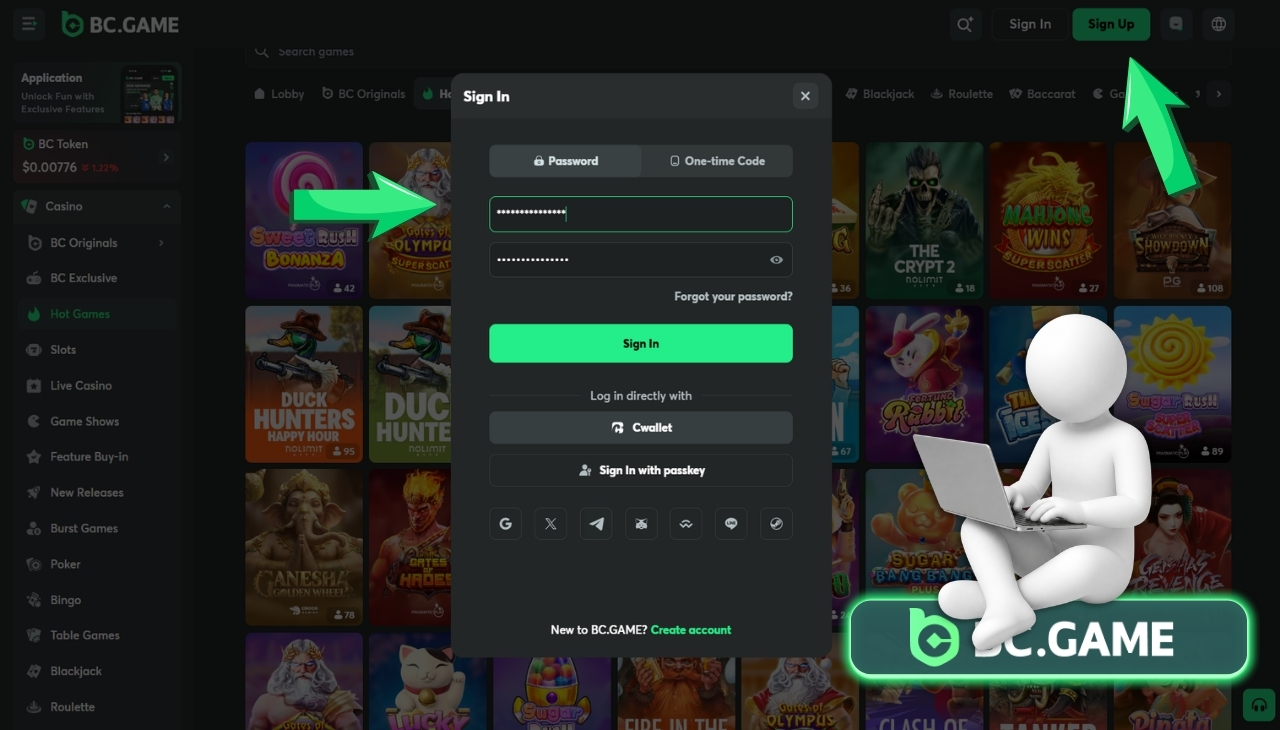
The login area lives in the top portion of the site. A “Sign In” button opens the form. Three elements sit inside it.
- The credential fields. Email or phone number on top. Password below. Both accept standard text input. The password field masks characters by default — dots instead of letters — with a small icon to reveal the text for a quick check before submitting.
- The recovery link. Positioned near the password field. Useful for anyone who hasn’t touched the account in months and drew a blank on the password.
- The registration path. For users without an account. Leads to a separate form. Name, email, password, agreement to terms. After registration, the first bc game crash online login happens immediately with the freshly created credentials.
- Below the main fields, icons for social and wallet-based login appear. These skip the email-and-password step entirely. The player authenticates through a connected service and lands inside the platform without typing BC.Game-specific credentials.
Technical and Access Challenges
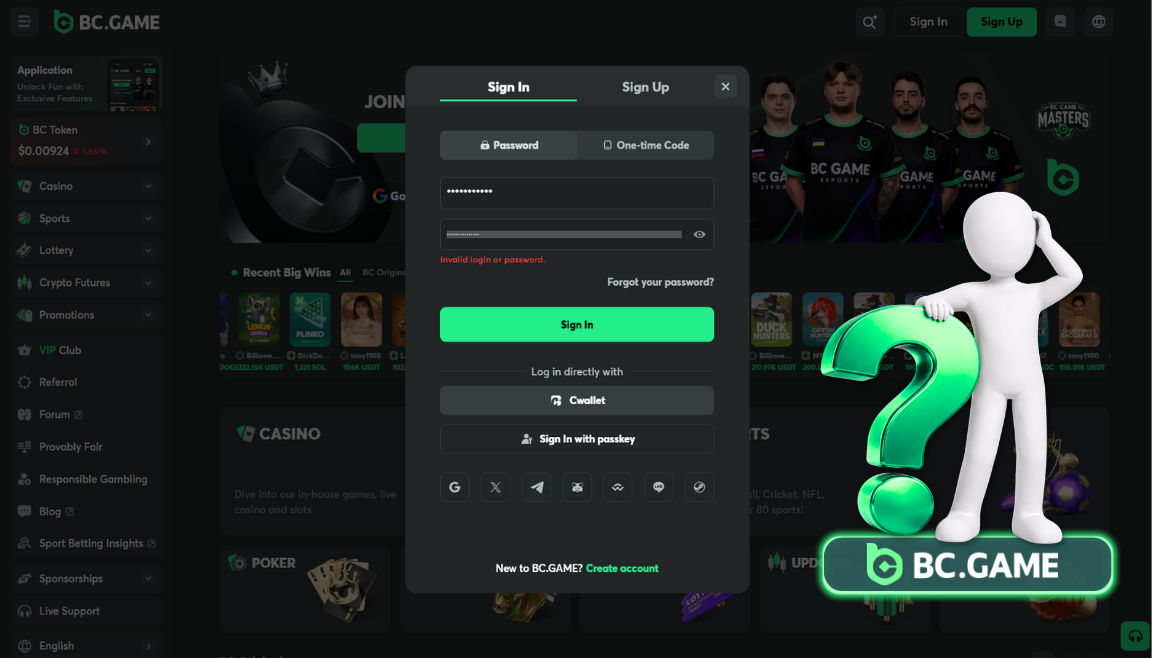
Sometimes the page doesn’t do what the player expects. A few situations show up regularly.
- The site loads but the login form doesn’t respond. An ad blocker is the first suspect — some blockers treat login forms as pop-ups and kill them. Turn off extensions. Reload. If the form comes back, one of the extensions was eating it.
- The credentials go in but the page loops back to the login screen. Old cookies. The browser is holding onto a dead session token and the server doesn’t know what to do with it. Incognito mode skips the cached mess. If login works there, clear cookies for the site in the regular browser.
- The page won’t load at all. Dead connection or the site is actually down. Try loading any other website. If other sites work, the problem is on BC.Game’s end. Their social channels usually post about scheduled downtime.
- Login works but Crash doesn’t load after. The account might have regional restrictions that block specific games. Or the game section is under a temporary update. The account is logged in — the game is the part that’s unavailable. Two separate issues that look like one.
Two-Factor Authentication
2FA puts a second wall after the password. Password goes in. Then the platform wants six digits from the authenticator app on the phone. Those digits change every half minute. Miss the window and the code is already stale — grab the next one.
Why it matters for crash game login specifically: the account holds crypto. Someone who got the password — from a data breach, from a phishing page, from reading it off a screen — still can’t get in. The withdrawal page demands the code. No code, no withdrawal. Balance stays.
The setup takes place in the account’s security settings. The platform shows a QR code. The authenticator app scans it. From that point on, every login and every withdrawal includes the code step. One-time setup. Ongoing protection.
One scenario players don’t think about until it happens: the phone breaks. The authenticator app was on it. The codes are gone. If the backup key from the initial setup was saved somewhere else — a note, a password manager on another device — the recovery takes minutes. If it wasn’t saved, the recovery goes through BC.Game support and takes considerably longer.
Staying Compliant with Platform Rules for Crash Game Login
The terms and conditions page exists for a reason beyond legal decoration. It specifies who can use the platform and under what circumstances.
- Age: 18 or older across the board. Some regions set the bar higher.
- Regional access: BC.Game blocks certain countries entirely. Attempting to log in from a restricted region — with or without a VPN — can result in an account freeze if the platform’s verification process catches the mismatch. The terms list which regions are off-limits.
- Account rules: one account per person. Creating duplicates to exploit bonuses or circumvent restrictions violates the terms and can lead to all accounts being closed, balances included.
- KYC: the platform may request identity verification at any point. Common triggers include large withdrawal requests, suspicious login patterns, and account age thresholds. Completing KYC before it becomes urgent prevents delays at the worst possible moment — when money is waiting to leave.
Safe Account Habits
A player at a friend’s house opens Crash on the friend’s laptop. Plays a few rounds. Closes the tab. Goes home. The session might still be active on that laptop. The friend — or anyone else who uses it — opens the browser, and the BC.Game account is sitting there, logged in, balance exposed. Logging out manually before leaving someone else’s device is the habit that prevents this.
Passwords sitting in the phone’s Notes app are readable by anyone who swipes past the lock screen. That entry labelled “BC Game” with the password typed out — right there, plain text, waiting. More like leaving cash on the kitchen counter in a shared apartment than anything resembling security.
Seed phrases for connected crypto wallets deserve the same caution. A player who uses Web3 login through a wallet has their wallet linked to the BC.Game account. The seed phrase for that wallet should never be typed into any website, pasted into any message, or stored in any cloud service. If someone asks for it, the request is fraudulent regardless of who appears to be asking.
Password Management Tools
Keeping a different password for every site is a job for software, not for memory. The phone’s built-in password saver fills login fields when the right domain loads. The player only needs to remember the phone’s lock code.
Third-party managers add cross-device access — phone and laptop synced. The BC.Game password inside the manager can be as long and random as the generator produces. Nobody types it by hand. The manager does the typing.
Here’s the part most players miss: the manager only auto-fills on the correct domain. A phishing page mimicking the BC.Game login won’t trigger the auto-fill because the URL doesn’t match. That moment — “why isn’t it filling in?” — is the warning. The manager caught what the eyes didn’t.
Recognizing Fraud Attempts
A message arrives: “Your BC.Game account has been flagged. Click here to verify your identity or your funds will be frozen.” The link looks official. The page behind it looks official. The login form on that page captures whatever gets typed and sends it to whoever built it.
Recognising these attempts comes down to noticing what doesn’t fit.
- Where did the message come from? Not from inside the BC.Game platform. Not from an email the player signed up with. It came through Telegram, or WhatsApp, or from an address that looks one letter off from the real thing. That’s enough to know.
- What is the page asking for? A real login wants email and password. A fake one might also want the 2FA backup key, a wallet seed phrase, or a “security answer” that the real flow never asks for. Extra fields = wrong page.
- Does the URL hold up under a second look? One extra word. A hyphen that doesn’t belong. A domain ending that isn’t the usual one. Small differences, placed there on purpose to pass a quick scan. Don’t give it a quick scan.
- Does the login page promise a reward? “Log in now and receive 500 free credits.” Real login pages don’t bribe people for logging in. If the form comes with a bonus pitch, it was built by someone other than BC.Game.